WANGECHI MUTU: HYBRIDITY, FEMININITY AND THE REALM OF THE GROTESQUE FOR BLACK WOMEN AND FEMMES
In this essay, Zoe Zikora Okeke explores how Wangechi Mutu uses hybridity, collage and the grotesque to challenge conventional ideas of femininity and beauty. Through an examination of Mutu's life and artistic practice, the essay considers how her work reimagines Black womanhood while confronting the social and political realities that shape it.
Zoe Zikora Okeke is a writer, essayist from Lagos, Nigeria.
Author
Zoe Zikora Okeke
Date
Read
6 mins
Art
Zoe Zikora Okeke
Date
Read
6 mins
Share
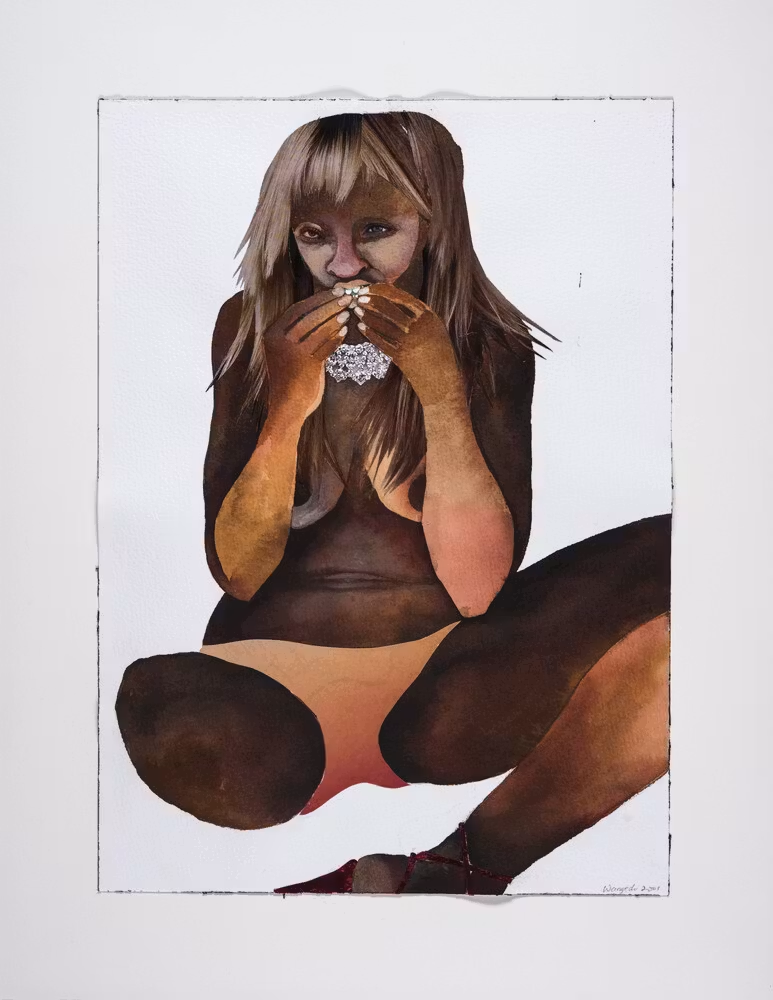
With deceptive simplicity, Mutu’s collaged figures exist in a state of hybridity. And although her work manages to problematize and give new meanings to public imagery, there’s an adeptness with which she renders them that, to my mind, encapsulates an artist in command of her style. Nothing feels contrived. These paintings mine urban anxieties into speculative fiction, satirizing them in a way that eschews conventionality and form. Still, there’s something elusive and eerie about the paintings: the experience of looking at them settles uneasily.
Perhaps, it’s a great disservice to the genius of Mutu to characterize her work by its discomfort. And yet, this unique countenance is one her subjects inhabit. Which is not to say they perennially emanate a dismal disposition. In their desolate moments, the figures embody the principle of social realism. In this sense, Mutu is passionately artistic as she is politically minded.
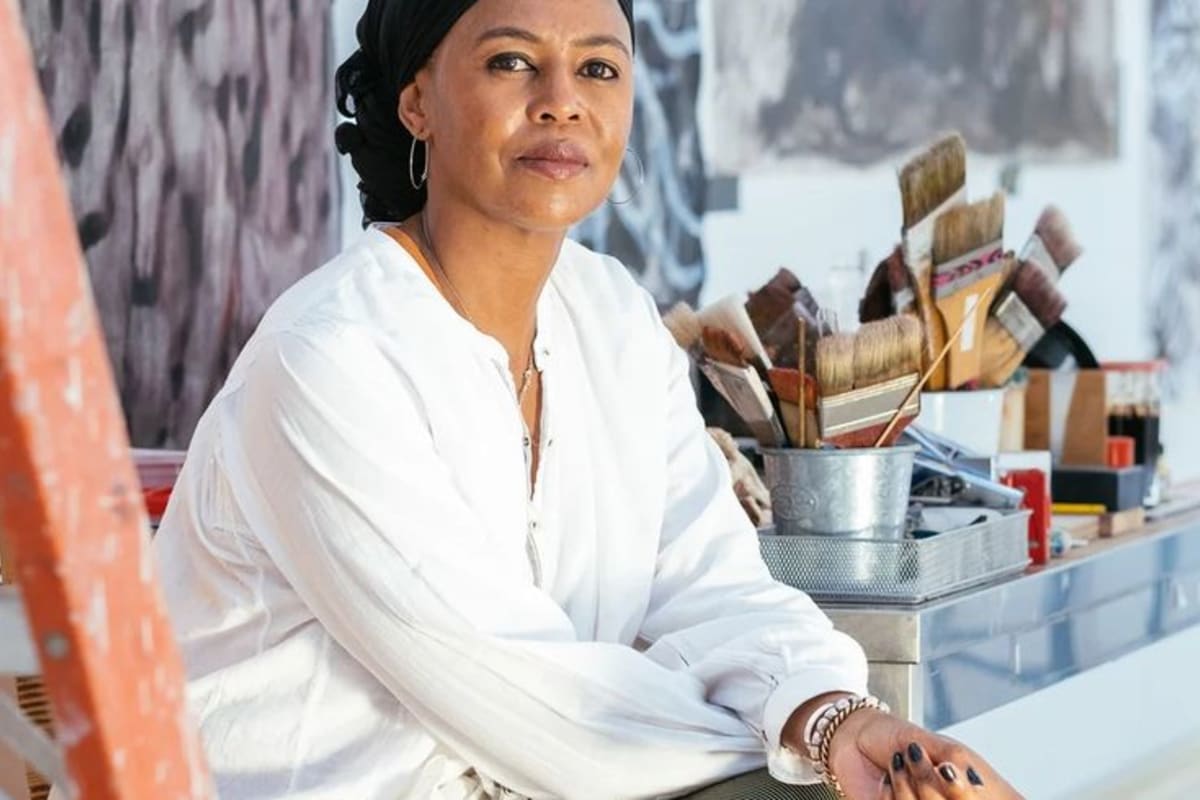
She was born in Nairobi in 1972, the child of a Kikuyu father and mother. Theirs was a protestant household and as a consequence, Mutu attended an all-girls catholic school. This proximity to femininity cultivated a feminist sensibility that runs through her work. Although primarily known for her collaged pieces, Mutu has experimented in other media - film, sculpture, and installation. Indeed, she is frequently so faithful to her esthétique it recurs throughout her oeuvre: the most prominent of which being the incorporation of human and non-human elements.
In a 2012 interview with Trevor Schoonmaker, Mutu was asked about the predominant leitmotif in her work: hybridity. She described it as an interest in ‘finding new ways to interpret the female portrait by questioning those qualities we look for when we identify something as ‘woman’ , or even ‘beautiful’. Going further to say: ‘What do the words mean? And how are they particular to, and part of, different histories? We sort of assume we are saying the same things and so run the risk of ignoring, of negating, the existence of people when we homogenize them.’ This sentiment is visible in her compositions as Mutu weaves with an expertness that conveys complexity, via disparate images. The collage form, in this way, is reproduced, altered, and distorted, titillating as well as disquieting.
Already nurturing artistic inclinations, Mutu left Nairobi for New York to pursue a professional career as an artist. There, she obtained two degrees - a bachelor of fine arts from Cooper Union and Masters of Fine Arts from Yale, in 1996 and 2000 respectively. Following her graduation, Mutu began working on her pin-ups (a mixed media series of ink and paper), which featured women with dismembered limbs.
Intended as a memorial to the victims of the Sierra Leone civil war, the pin-ups sought to illuminate acts of monumental violence. But there’s a passive quality about these figures: as though, for them, mutilation was a commonplace phenomenon. Yet any indication that these women are inoperative - and as such disposable - is rejected. And rather than being relegated to grotesque caricatures, they simply are. These figures become the foreground, and in this way viewers inevitably ponder the fraught reality of the disabled subjects.
Untitled - pinup series (seated girl)
The motif of the black female body as emblematic of society’s ills is one that recurs throughout Mutu’s compositions. In Misguided little Unforgivable Hierarchies (2005) three hybrid figures are perched atop one another in a triangle representative of their class positions. The figures follow successive roles,
appearing smaller and smaller. Round them, tall elephant grass sits in an uncharacteristic gray - perhaps alluding to an altered state that inevitably follows war or disruption of any kind.
Mutu also engages with stereotypes here. The banana-shaped breasts jutting out of the front and back of the biggest figure bring to mind: Josephine Baker. The African-American entertainer who “was said to have performed bare-breasted in a jungle setting for parisian audiences in what was known as a rump-shaking banana dance.” (Patricia .H. Collins, Black Sexual Politics, 36)
Mutu has spoken in an interview, of the collage medium as analogous to the science of sifting through the stool of a pachyderm, for examination of its digestive system: ‘if you want to know what an animal system is, where it’s been, and whether it’s healthy, you look at its shit, like elephant dung [...] That's a little bit of what it's like when I look at media [...] it’s not the most high-end knowledge but it definitely gives you a cross-section of what is going on.’
It isn’t conjecture, then, to say Mutu is interested in knowing what we think. How do we arrive at what we know, even as empirical evidence points to the contrary? All the same, whatever constitutes general reality, surely cannot be inferred from mainstream media - that bastion of artifice and flourish. (Susan Sontag writes in On Photography: “Photographs furnish evidence. Something we hear about, but doubt seems proven when we’re shown a photograph of it.”) This is true of the media we consume. Lodged in our minds, it takes root, consolidating itself as an arbiter of all knowledge.
Femininity, of course, is central to Mutu's artistic practice. Yet the imagistic approach is one of ambivalence and intensity. Discernibly feminine as her subjects often are, they also possess contrasting elements: unusually large heads, acid skin, limbless bodies, et al. This induces a sense of disquiet even as the resulting effects are incongruous. The serpentine figure hovering amid a polluted skyscape in The End Of Eating Everything is a menacing character - she sports a baleful look as she hungrily devours a flock of crows. Reconstituted to be a ‘moving ship,’ she carries along with her industrial detritus, amongst which are flailing arms - as though to indicate complicity. She’s also given the characteristics of a maternal figure, whose aims, it seems, are fueled by frustration. Her gluttonous appetite eventually gives way to an implosion, an event that coincides with the emergence of a new world, free of toxins.
Regarded as a treatise on consumerism, the animation speculates on the impacts of ecological crises, particularly, Mother Earth’s response to the assault inflicted on her. As Santigold - who plays the serpentine figure in the animation - suggests in an interview with Mutu: ‘what happens when the pendulum turns, when you’re so far gone that there’s nowhere else to go but an implosion?’
Consequently, the meta-data of society is disclosed in all of its unsettling details: misogyny, ecological disasters, and the ubiquity of whiteness. There’s an impulse then to categorize Mutu’s work as autoethnographic, though she rejects neat labels. The point isn’t cohesion; her collages are ambiguously rendered for that reason: to repudiate the validity of binaries so that hybrid realities are brought to the fore.
With nearly 10 million new voters added to Nigeria’s register, we spoke to first-time registrants across the country about what pushed them to register and what they expect from the next election.
In this essay, Tobi reflects on The North, a film about two friends walking 600 km through the Scottish Highlands and what it has to say about friendship and time.
In this essay, Zoe Zikora Okeke explores how Wangechi Mutu uses hybridity, collage and the grotesque to challenge conventional ideas of femininity and beauty. Through an examination of Mutu's life and artistic practice, the essay considers how her work reimagines Black womanhood while confronting the social and political realities that shape it.
Zoe Zikora Okeke is a writer, essayist from Lagos, Nigeria.
 Go Back