To Those On The Outside Peering In.
In this essay, Grillo Adedolapo explores the fragility of trust and the ease with which love and friendship can dissolve into emptiness and distrust.
 Go Back
Publications
In this essay, Grillo Adedolapo explores the fragility of trust and the ease with which love and friendship can dissolve into emptiness and distrust.
Author
Grillo Adedolapo Oluwalogbon
Date
Read
5 mins
Essay
Grillo Adedolapo Oluwalogbon
Date
Read
5 mins
Share


To those on the outside peering in, our stories that you watch in confused enthusiasm are illusions. They are a series of pictures strung together like a movie at the cinema for your entertainment. Reality isn’t what is—it is what appears to be, what we want you to see. Sometimes, our laughs are only skin deep. Our frowns are only etched on our brows. Our hearts do not crease in pain or take flight with joy. We are told the face reflects the thoughts of the heart. But if that were so, should we not be able to recognise evil long before it assails us, or kindness before we disregard it? Shouldn’t we be able to discern the thoughts of enemies disguised as friends long before they remove their affable cloaks and reveal their hostility? Alas, the face refuses to betray the thoughts of the mind. It is, in many ways, a true friend—forever loyal, revealing only what we wish it to.
It is why the subject of friendship troubles me, and should trouble you too. How do we trust what we do not really understand? How can we claim to understand our friends’ true feelings when we can never truly tell what they think? Sometimes, when we sit in our little booths of comfort, laughing and drinking, basking in the frustrations and joys of our lives, shouldn’t we sometimes stop to wonder if the laughter from a friend is genuine or if there is a hint of hypocrisy in the tears they shed with us? Should we not sometimes wonder whether their loose words are the true reflections of their minds? That they are playful taunts that should be forgotten, like the whispers of a wind on a very sunny day?
I sometimes wonder if I can trust that charming smile from a friend, hoping that it does not hide a malicious intent. I wonder if I should rest, not knowing if the tears shed together were genuine, or if it was all just a performance worthy of an experienced thespian. I am curious to know if the "I love you" that they say in a million ways is true and not just hollow mutterings echoing through time.
Colour me paranoid, but I fear! I have seen wholesome friendships dissolve like the mists of dawn, as if they never existed. I have seen marriages shatter into nothingness. I have seen love dissipate like it was never there. And I have seen those who cling to love after it has gone; those who force themselves to remain together for the sake of those who are outside peering in; I have seen them dry up into phantoms of distrust, who only tolerate themselves with no affection. I have seen them become ready vehicles for hate.
We are then left with the questions: "How does love transform into hate?" "How does hate metamorphose into love?" Many have theorised that there is a thin line between the two. Hence, it is easy to cross between both states. Sometimes what we call hate is a deep, unrequited love, passionate as the raging sea; and what we call love is a masquerading hate, always subtle, never forceful. This is the line friends are called to tread—the divide between hate and love. And we do it perfectly until we can no longer do it anymore.
It is worse in today’s world, where loyalty can be sold like a Kongo of Garri in the marketplace and honour is an aged idea from the past—a withering soldier abandoned by his comrades. What we now call love is simply an exchange of ingratiating feelings—a sycophantic presentation of what should be. Friends betray each other without a care—isn’t the world a battleground where only the fittest survive?
We engage in calumny, deliberately hurting each other to advance personal gains, and so the lines between hate and love are made thinner and blurred until they become inconspicuous. In today’s world, a friend will steal your man while other men are courting her. A man will cheat on his wife repeatedly but claim to love her, and she, knowing what he is, will accept his claims of love to maintain a blissful marital facade and smile coquettishly for the camera—the very picture of virtue. A friend will sell out the other for money without a second thought—this is the love that we celebrate today.
Hate also wears a veil. In a world where we can be blinded by extreme flattery, it is sometimes the sting of an enemy that allows us to see with greater clarity. Unfortunate as it is, this form of clarity is the norm, and it is then we discover ourselves—our strengths and weaknesses. It is then we live the mantra: “I love me for me”. Only that once we are healed, we blind ourselves again to the pattern and are doomed to repeat it. In today’s world, hate is love, and love is hate. It is a senseless wheel that might never stop turning.
To those outside peering in, our appearance is a brilliant façade, crafted so delicately and deliberately that we have become the disguise. Our mien is a pretense designed to make you believe something that we are not. Do not blame us too harshly. We do not know ourselves to be pretenders. We have seared our minds to believe the lies we tell, and once again, like the love-hate paradox, the line between truth and falsehood has become inconspicuous. "Why is something a lie when we are convinced it is true?" "How can something be true when we believe it is false?" You can only believe what you see, but what you see may not be truly what is. What is, however, is what we want to be, which might not necessarily be what should be. Hence, we run around in circles, befuddled and confused, plunging ourselves deeper into frustration and anger.
To those who are outside peering in, you may wonder why we wear masks to hide who we are and why we pretend to be what we are not. It is simple. The mask is a trick to hide the scars and, worse, the wounds. The mask is an illusion. You should be able to guess that by now, as it is becoming more difficult to hide what we are and to pretend that everything is the way it should be. I wonder sometimes why we are so afraid of ourselves. “Why can’t we be alone with ourselves? If we are alone, what do we find? What startling detail do we unearth?” We are afraid to know. What we don’t know does not exist and, therefore, cannot hurt us. So, we hide from our nakedness and garb ourselves in the softest silks of lies and pretence. “Who is to know what we ourselves pretend not to know?” It is no wonder that life seems to lack purpose. What purpose can be found in an unexamined life? Can true happiness be found in such a life of perpetual fear of who we truly are?
To those peering in, don’t blame us for hiding from ourselves. It is only logical to run away and hide from monsters, even if the monster is us. It is a fearful thing to realise that we are not so perfect and that we are flawed. But I find it intriguing how we deal with this realization. We dispute with ourselves and the world. I have learned that it is unseemly to accept who we truly are when we can claim to be somebody else. Sometimes, we toss the blame on something else. "I am Sagittarius"; "I was born in the month of August, so I can be rude"; "He should be allowed to behave badly. He is a child". The entity we blame the most is the devil. "It is the devil’s doing". I find it interesting that we blame an entity whose existence we spend our lives disproving.
The question humanity must answer today is straightforward: "Who are we?" Yet, as simple as this query may seem, it leads to several complicated answers, all of which affect our daily lives irrefutably. We don’t seem to know who we are, and we deny the glaring truths before us. Red is no longer red. White is no longer white. We concoct events, situations, and fantasies so as to be more comfortable with ourselves. We become unrecognisable in a bid to understand ourselves, complicating what should be the easiest and simplest of queries, "Who are we?"
To those on the outside peering in, I am befuddled by the times in which we live. It is a time when the truth is sugarcoated to remove its acrid taste. It is a time when foolishness is celebrated and malady is crowned in gold. But you are blind to all of this, aren’t you? You only see what we want you to see. I wonder what you will think of us when the mask is finally unveiled and the scales fall off your eyes. But until then, I bid you to enjoy the show.
Essay
Joshua Omoijiade is a writer and multidisciplinary designer from Lagos whose work explores freedom, dignity, and what it means to be human in a world still shaped by forces larger than any one person. Drawing on philosophy, pop culture, theology, and the built environment, his essays ask what we owe each other and how we build a world that reflects that. In this essay, he reflects on the tension and aggression of everyday life in Lagos, using Frantz Fanon’s The Wretched of the Earth to explore how colonial violence lingers in the present and questions whether kindness can exist as a radical response.
Author
Joshua Omoijiade
Duration
8 mins
Essay
In this essay, Glory Ibanga writes about how love and romance in Nigeria have shifted from simple, meaningful gestures to expensive displays driven by social media, class differences and gender expectations. Glory Ibanga is a lawyer and writer based in Lagos. Her goal is to share her gifts fully through her writing. Find her on Instagram @_joyfulglory or Medium [https://medium.com/@glorieibanga]
Author
Glory Ibanga
Duration
8 mins
Interview
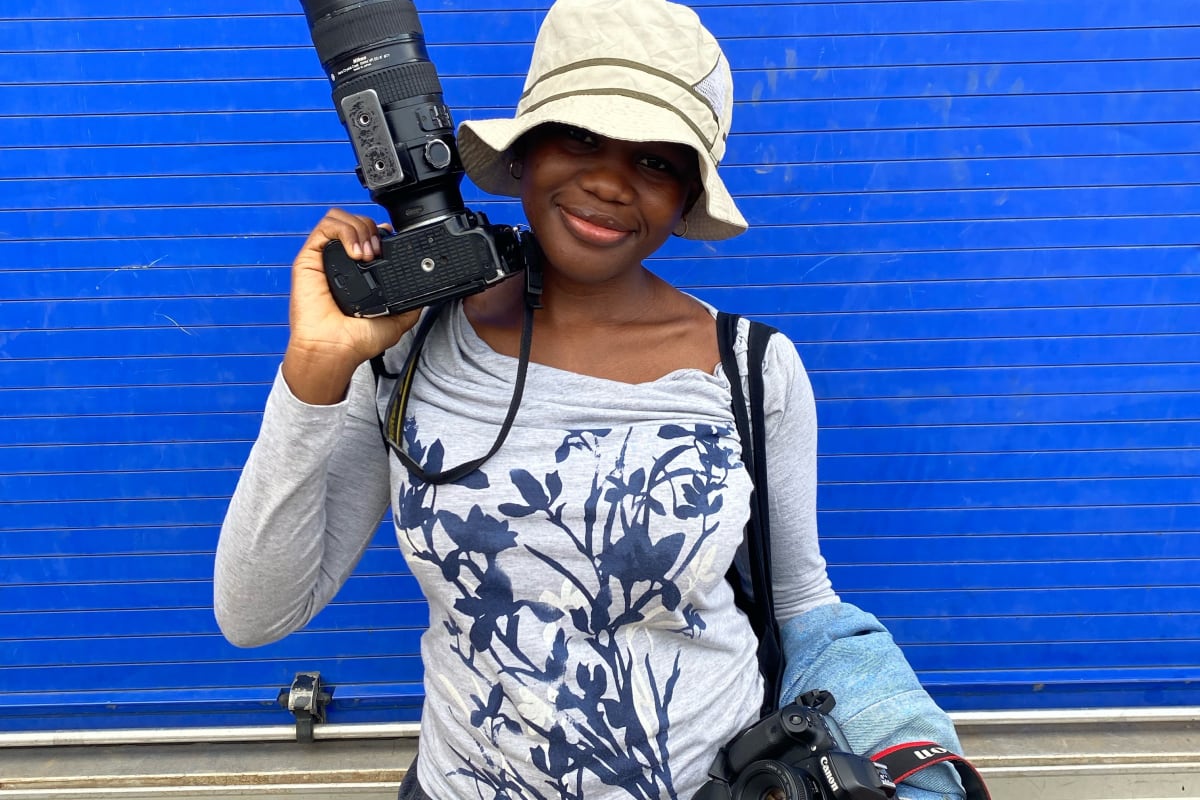
Coltan Kubiangha is a Nigerian Photographer and Storyteller whose practice is focused on documenting people living with visible differences through portraiture, especially from genetic conditions such as Neurofibromatosis and Trichoepithelioma, as a way to create awareness with the intent to improve the manner in which people with these conditions are perceived and treated by society. Tobi Are speaks to them for Taxi and touches topics like their photography, posterity and their projects to document people living with visible difference.
Author
Tobi Are
Duration
11 mins