Right arrowGo Back

Publications

IN CONVERSATION WITH COLTAN KUBIANGHA: PHOTOGRAPHY, POSTERITY & THE BEAUTY OF DIFFERENCE.

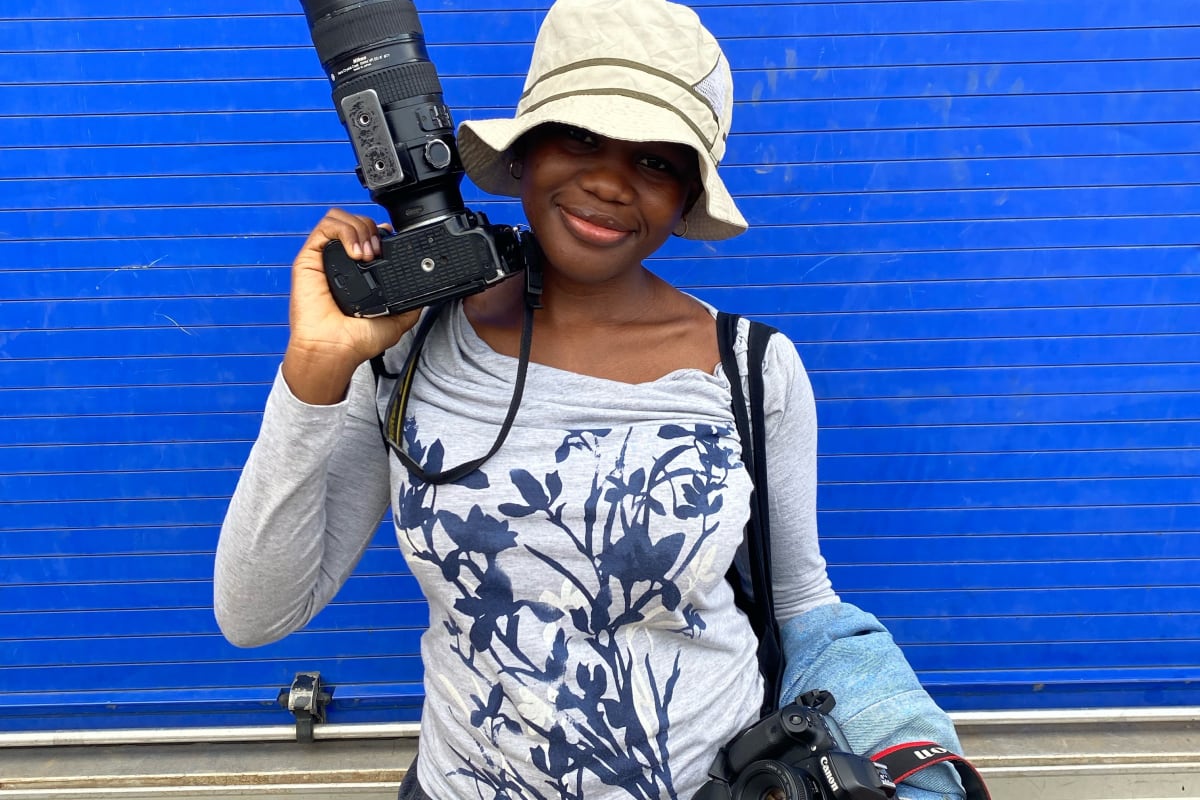
Coltan Kubiangha is a Nigerian Photographer and Storyteller whose practice is focused on documenting people living with visible differences through portraiture, especially from genetic conditions such as Neurofibromatosis and Trichoepithelioma, as a way to create awareness with the intent to improve the manner in which people with these conditions are perceived and treated by society. Tobi Are speaks to them for Taxi and touches topics like their photography, posterity and their projects to document people living with visible difference.

Interviewers

Tobi

Date

Read

11 mins

Interview

Coltan

Coltan Kubiangha is a Nigerian Photographer and Storyteller whose practice is focused on documenting people living with visible differences through portraiture, especially from genetic conditions such as Neurofibromatosis and Trichoepithelioma, as a way to create awareness with the intent to improve the manner in which people with these conditions are perceived and treated by society. Their practice also focuses on the documentation of indigenous cultures in Nigeria as a means of creating an archival visual history of these cultures for the future, while increasing connection with the culture and traditions in the present. Coltan is a member of Black Women Photographers, a global organization of Black Women and Nonbinary Photographers, and the African Photojournalism Database, a joint project of the World Press Photo Foundation and Everyday Africa.

Tobi Are avatar

Tobi Are

Date

Read

11 mins

Share

Instagram logoTwitter logoYouTube logo
Tobi:

Hi, Coltan. It's so great to talk to you. How are you feeling these days?

There’s an Instagram caption on one of my random photo dumps recently that says, “Alternating between a stellar life and utter desolation: a summary of the human experience.” It's much more of the latter these days, so not great. I figured if I was going to answer that, I might as well do it honestly—not with a generic “I'm okay.” Maybe in a few years, I'll be able to look back at this and say, “When I did that Taxi Editorial interview, I was going through it, but oh look! Life is better now.”

Tobi:

That makes two of us. You divide your time between Abuja and Calabar, and I know that for many artists, the subject of home is something powerful and singular. Warsan Shire writes, “I want to go home, but home is the mouth of a shark.” When you think of home, where comes to mind? What makes it feel like home?

For the most part, I think of Calabar. Although that question could easily trigger an existential crisis, because I'm inclined to say “nowhere”. But I lived there for about the first 20 years of my life. It also feels like home because of Ekpe, to be honest. No matter how much talk there is of [Calabar] “falling off”, and how much just about everybody's moving, there's nothing quite like the festive spirit during the holidays around December and the New Year. And most importantly, it feels like home because of the people who are fixtures there—like my father. Home just becomes permanently associated with them.

Tobi:

So, random lore drop: I had a photography phase. Well, I tried to get into photography, but I guess it didn't stick. It was just one of those things. But yours clearly did. How did your journey in photography begin? What drew you to it?

As a way to express myself, more than anything else. It started as what people would term a hobby, and I suppose it was to an extent, but for the most part, it was just the natural progression of things. Photography was always where I was going to end up, and I just got there when the time had come for me to find it. Which, in less cryptic words, means I started out in SS2 or SS3 with the first [Android] phone I ever had, given to me by my mother. I was immediately good at it. I knew from the fact that everyone attested to that as soon as they saw the photos I took. That only came on about two years later, though. When I first started, I was rather hounded with statements like, “What rubbish are you snapping?” and such. Unfortunately, those closest to me weren’t exempt. I was always photographing one thing or the other, so it was easily misconstrued as a distraction and not encouraged—but I’ve never not done something I wanted to do because of what people were saying. I have 14-year-old me to thank for that. I just kept at it until I found myself in more photo-related spaces. When I got into university, instead of doing an internship at the Tourism Bureau—where most of my mates were going—I went somewhere where I could work as a photographer and get more photography experience.

Tobi:

What drew you to documenting visibly different people?

My family, very simply. I grew up spending a lot of time at my [maternal] grandmother’s house—because she lived less than 10 minutes away [from our house]—and a lot of my cousins were there all the time. I would say we were a close-knit extended family. This is relevant because my grandmother had a rare genetic condition called trichoepithelioma; as did most of my cousins that I interacted with every day, and my mother, most of her siblings, her cousins, my grandmother's siblings; a lot of people. You get the idea. The condition physically presents as small tumors on the face, so difference has always been familiar to me. It was just at a certain point in childhood that I began to conceptualize that difference was not familiar to everyone else, but rather something to be feared and ostracized, which was very weird to me. Anyway, I think the direct answer to your question is that I didn't start out deliberately trying to document visibly different people. I started out photographing my family as just that—people close to me and people I loved. It was the ignorance of people in the years that followed that served as a catalyst for me to reevaluate exactly what message I wanted to pass with my photography. That message was the simple idea that people with visible differences are just as normal as everyone else, and they deserve to be treated equally in society. I eventually moved from photographing just my family members to documenting other people with a vast array of visible differences—vitiligo, albinism, neurofibromatosis, and even some conditions that I didn't know the names of, and neither did the people who have them.

Tobi:

Yeah, I mean, there's a general sense of beauty that is being fed into the world. There's also a subjective meaning of beauty for everyone. What has documenting differences taught you about beauty? How has it formed your own definition of beauty?

I never believed in normative beauty standards to start with. And it wasn't just documenting difference that taught me about beauty, because before I began to document difference, I was already surrounded by it. I already thought my mother was one of the most beautiful people I've ever seen, and she has always had Trichoepithelioma for as long as I've known her—as do most of my family members—and I still think they're beautiful. I always did think that way. Documenting difference has taught me that beauty is beyond what society dictates that it is. People can be beautiful in different ways. And this is not just about the inner beauty that people refer to when they don't want to tell you they don’t find you attractive. They say things like, “Oh, you're such a beautiful soul. You're such a beautiful person inside.” No. I document visibly different people with genetic and physical conditions. And I think they're beautiful the way they are.

Tobi:

Apart from highlighting amazing work like that, there are still different aspects to it. You have spent time documenting festivals like Nyoro Ekpe and Osun-Osogbo. What draws you to cultural ritual?

What makes me document those festivals in particular is that I didn't see documentation of Nigerian culture the way I wanted to see it. It's not that people weren’t doing it before me, but I never quite saw documentation of these cultural events and articles of culture in the way that I wanted to see them. What draws me to cultural ritual? Maybe my background. I'll drop some lore here. I'm from an Efik royal family several generations back. My maternal family is Efik royalty, so I was deeply entrenched in the culture. I became fascinated with it at a young age. From childhood, I always knew that not many people knew much about their culture or were as deeply entrenched in it. So it became an integral part of my personality several years before I even ventured into the work. Of course, I extended it beyond just Calabar [where I grew up]. I started documenting other things as well, like Osun-Osogbo—wherever I can access cultural events or rituals, as you term them.

Tobi:

That is amazing work. I agree with you on this. There isn't much preserved content about Nigeria and its history. That's why people like Archivi.ng and even you are doing amazing work. And who knows, maybe 50 years from now, a photograph you would’ve taken would end up somewhere like that.

Who knows?

Tobi:

Being in these kinds of spaces, going there and acting as a documentarian, you might want to also be a part of it, be in the middle of it, to really feel it. So how do you balance being a participant and an observer, while knowing you are there because you want to capture a piece of history?

By making time to stand still. It applies to all of the cultural festivals I participate in. There are times I will put the camera down. In fact, sometimes I do the exact opposite of what everybody's doing. You see other people scrambling to get a particular shot because a lot of times, these events are very chaotic.

Tobi:

Yeah, it's a lot of crowds.

I've learned to navigate crowds over time. If you don't know how to move with the whims of the crowd at a particular time, you're going to end up not getting the shots you want. I also learn about the events beforehand. I research what I'm going to photograph. Like with Osun-Osogbo, I knew that the Arugba would come out at a particular time. Sometimes I've envisioned the shots I want. That helps me to take my shots faster than I would if I did not know what was going to happen. I also make a conscious choice to participate. Media people typically wear black-on-black, or a very generic attire that you expect of media people. I make an effort to dress as a participant. I wear the traditional attire that is called Onyonyo. It's like a big flowy dress. And it's not very functional when you're trying to take photographs or roam about. But every year I've documented Utomo Obong or Nyoro Ekpe, I've always been wearing one of those. So that, at any point, I can put the camera down and easily blend into the crowd. I become a participant the moment I drop the camera.

Tobi:

Typically, what does prep look like for you before you shoot? Do you storyboard or do you just go in and feel it out?

For documentary work, I don't storyboard anything. The most I will do is research the event beforehand. That guides my process. I don't make a mood board because documentary photography requires you to be present. It's more of capturing, like with photojournalism. You have to document what is there. You're not orchestrating the moment. There's an aspect of documentary photography where you can do posed portraits, but for the most part, at these events, it is documenting the moment as it happens—even when I'm doing portraits, unless it's commissioned work or because the client has a mood board that they want to work with. I typically would show some of my other work so you are familiar with what my work actually looks like, what my editing style is, which is not a lot. I hate retouching. Let me just throw that in there. It's important that the person knows what my work looks like, so you're not asking me to do something that isn’t in my style. Maybe that will change in some years to come, but as of now…

Tobi:

You just go with the flow. I get that. When you look back at all the work you have done and imagine yourself 10 years from now, what do you see?

Wow, existential crisis.

Tobi:

The famous existential crisis question.

I think I will have a lot more visibility for my work. I'm at a stage where I’m actively creating visibility for the work. In fact, I'm trying to pivot from just online spaces. I know a lot of people have come across my work online, and it's so integral for it to be online, because a lot of people occupy those spaces. It's important for people to see the work there and engage with it, as I'm trying to shift perspectives about people with visible differences and all that. But I'm trying to pivot at the moment to physical spaces. I want people to start experiencing my work in person, physically. Think exhibitions, workshops, spaces where they get to see the work, and I talk about it. Also, people who actually have visible differences get to talk about it—whether that's my family members or whoever else might be in those particular images at the time, because, as you can see, I don't have the distinct features of my family. I like to say I'm amplifying their voices rather than giving them a voice. It's more about creating a space for them to talk about their experiences and whatnot, so in 10 years, definitely a lot more people will know about my work. I want my name to be synonymous with visible differences. Other people have niches like that; you hear a particular name and you think, “dark, moody portraits” or a specific style of photography. I want the same thing for myself, but not necessarily because of the image style, but because of the image composition, what it entails, what is in the photograph, as soon as the viewer sees it. More importantly, I hope my work would have caused a significant shift in Nigeria, at the very least. That's how I want to measure my own success. In the same way that vitiligo has become relatively well known, I want that for trichoepithelioma and many other conditions. I want people to drop the general mindset of associating difference with things like witchcraft and all the rest, to know that this is just a rare genetic condition, or just a thing that happens. Humans come in different forms and shapes, and sizes.

Tobi:

It's just the body being a body.

Exactly. So definitely, my work is going to be at the forefront of shifting perspectives on visible differences and disabilities. And I know more people will be inspired and come in to also work in the same field. I would also like not to be poor, but that would be an added bonus. Obviously, I would like my work to sell—my images of cultural articles and whatnot. I would like those to change my living situation, but until then.

Tobi:

Is there a project or story you haven't done yet but feel you need to?

I've been working on a series called Faces of My Family, and I want it to evolve into something slightly different than what it is now. I would also like to get proper funding to work on it on the scale that it needs to be told on. Faces of My Family is exactly what it sounds like: documenting my maternal family that have trichoepithelioma, to create awareness. But also, yes, documenting people with disabilities. I started with documenting children at a school for the deaf and hard of hearing, but I want to do that on a much larger scale as well. And I haven't gotten the chance to start working on that yet. I also want to document people with a lot more visible differences than I'm doing now. I have a small pool of [photography] subjects that I'm working with at the moment, which is, aside from my family, a few other people that I have seen that have visible differences that I've been able to interact with and photograph. I want the pool of individuals and photography to extend, really.

Tobi:

I can't wait to see what you have in store. Naturally, you wouldn't always be taking photographs, so is there anything that you're reading, watching, or listening to, and which photographer is inspiring you right now?

I’m reading Necessary Fiction [by Eloghosa Osunde]. The author sent me a copy, so I'm better than everybody else. I've been reading it rather slowly. But I think that's the pace the book wants me to read it at. I'm watching Alchemy of Souls. It's a K-drama, and I'm re-watching it for, I think, the sixth time. My story is very touching, I don't know whether I should end this interview like this. But I've uninstalled both Spotify and Apple Music because I don't have space on my 64 GB phone. So, I'm not listening to anything at the moment. Which photographer is inspiring me right now? Myself. Because I am persevering despite the odds. But I do have a relatively more extensive answer to that. Being a creative in Nigeria is needlessly exhausting, with problems you shouldn't be facing, like getting opportunities, and when they hear that you're Nigerian, the story changes. I wouldn't say any one photographer is inspiring me, but Nigerian photographers as a collective are also persevering despite the odds against them. People are doing so many great things, like getting residencies in so many different countries outside the continent and exhibitions. And even those that are not “succeeding” in the ways that we would typically expect are still continuing to make their work until such a time that they do gain widespread success and all that. That’s inspiring.

Latest Posts

A right black arrow

Interview

Article image

IN CONVERSATION WITH COLTAN KUBIANGHA: PHOTOGRAPHY, POSTERITY & THE BEAUTY OF DIFFERENCE.

Coltan Kubiangha is a Nigerian Photographer and Storyteller whose practice is focused on documenting people living with visible differences through portraiture, especially from genetic conditions such as Neurofibromatosis and Trichoepithelioma, as a way to create awareness with the intent to improve the manner in which people with these conditions are perceived and treated by society. Tobi Are speaks to them for Taxi and touches topics like their photography, posterity and their projects to document people living with visible difference.

Author

Tobi Are

Duration

11 mins

Essay

Article image

DNA Guarantee.

Stuck in middle-of-nowhere-probably-isnt-lagos Lagos, Desire O(they/she) thinks every sentiment deserves a conduit. You can find them in front of the dj, in the lab, or writing feverishly, body over pillow in their journal.

Author

Desire O.

Duration

8 mins

Essay

Article image

Year One at Taxi.

Tosin Okewole (She/Her) is a writer and the founder of Taxi. Her work has appeared in Brittle Paper, Archer Magazine and Oranges Journal. She previously served as a prose editor at Spiritus Mundi Review. She is interested in the complexities of storytelling and works across all forms of prose. This desire to tell important stories led her to launch Taxi, an editorial that uses various mediums to convey narratives. She draws inspiration from authors like Sally Rooney, Teju Cole and Franz Kafka. Outside literature she is a crossword enthusiast with interests in etymology, film and Odunsi’s music. She plans to pursue a degree in mathematical economics when she turns 30.

Author

Tosin Okewole.

Duration

10 mins